

This is Water
On awareness, division, and the work ahead
I wrote this Substack before the killing of Alex Pretti, and before I begin this reflection and introduce the direction I’ll be taking this work, I want to take a moment to talk about Alex.
Alex Pretti was a 37-year-old intensive care nurse at the Minneapolis Veterans Affairs Health Care System, known by friends and colleagues as kind, compassionate, and dedicated to caring for others throughout his life and career. He was killed by federal law enforcement agents in Minneapolis during a federal immigration enforcement operation, becoming the second Minneapolis resident shot and killed by federal agents in recent weeks. Pretti had no serious criminal history beyond minor traffic offenses, and video of the incident shows Pretti recording federal agents with a phone as he attempted to help up another person – not brandishing a weapon at the time he was fatally shot.
Alex’s life was defined by service: caring for veterans, advocating for human rights, and showing up for his community. In another video circulating online of Alex at work, Alex honors a late veteran with words I’m holding onto:
“Today we remember that freedom is not free, we have to work at it, nurture it, protect it, and even sacrifice for it. May we never forget our brothers and sisters that have served so that we may enjoy the gift of freedom.”
Those words matter because Alex lived them. And now the question is what it means for us to live them, too. If freedom is something we nurture and protect, then honoring Alex means deciding how we show up in this moment, for our neighbors and for one another, and for our country moving forward.
With that in mind, here are five things you can do right now:
Follow local journalists and subscribe to substacks. TikTok creators are actively getting suspended for posting ICE content. @minneapolisward2 @racialjusticemn @sahanjournal @bygeorgiafort @indigenousfoodlab @nekimal @natifs_org @freemahertarabishi @minnesota50501
Boycott Amazon, Home Depot, Lowes, UPS, FedEx, Comcast, Ring, Apple, Google, Microsoft, Hp, and Dell. These companies have contracts with ICE and/or have sway with Trump. If we cause financial pain in response to Alex’s murder, ICE will see fewer resources and companies will be forced to act. Alternatives: Costco, AceHardware, TrueValue, USPS. If you can’t cancel Comcast, cancel any associated products (like Peacock). And buy used – do not buy new products from the tech giants.
Prepare: Start or join a rapid response group in your neighborhood join a local Indivisible Chapter- do not wait for ICE to come. Let’s take advantage of having an inspiring model in Minnesota and prepare as best we can.
Support the Resistance: Support local Minnesota businesses and mutual aid organizations like the Immigrant Law Center of Minnesota, MPLS Mutual Aid, and Stand with Minnesota’s list of organizations.
Defund the Operation: ICE agents came to terrorize but also because it pays. The Senate is set to vote this week on a massive House-passed $1.2 trillion package to fund the Department of Homeland Security. Set a reminder to call your Senators daily for the next week to Defund ICE.
What Alex’s death makes painfully clear is how easy it is to lose our bearings in moments like this. To be pulled entirely into urgency, outrage, fear, and reaction. Those responses are necessary. But if we stop there, we risk missing something just as important: the conditions that allow this kind of violence, erosion of freedom, and moral fracture to feel normal, inevitable, or out of our control. We also need to understand the water we’re swimming in — the forces shaping our attention, our fear, and our sense of what’s possible — so that we don’t just react to crises, but change the conditions that produce them.
That’s why, as I think about the midterms and the direction I want to take this writing, I keep returning to a speech by David Foster Wallace.
…(entering the original Substack post)…
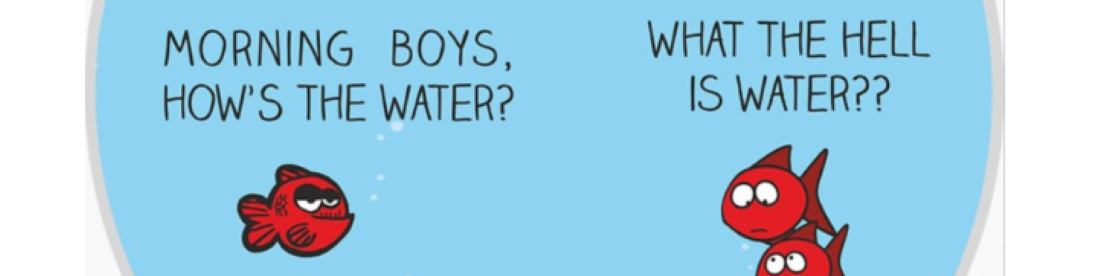
DFW gave a graduation speech at Kenyon College I have always loved called This is Water. He starts his speech with a story:
Two young fish are swimming along when an older fish swims past and says,
“Morning, boys. How’s the water?”The two young fish keep swimming.
After a while, one turns to the other and asks,
“What the hell is water?”
The point of the story is simple: the most obvious, important realities we’re swimming in are often the hardest to see and talk about.
I think part of the reason we’re in the mess we’re in right now is that we aren’t aware of the water we’re swimming (ahem: drowning) in. So many of us — myself included — are moving through our days half-awake, participating in the very forces that are making our society sick and hollowing out our democracy. One of the clearest examples is our relationship with social media. We have a vague (or strong) sense that participating in it feels wrong, that it’s corrosive or unhealthy. But do we really understand the extent to which we’re feeding a machine that thrives on division and distraction from our most pressing problems? Have we prepared to escape it when it has become our public square? And more importantly, do we remember that it doesn’t have to be this way? Or will we keep sleepwalking, and one day wake up to a country we did not consciously choose?
When I started 150 Reasons with my law school classmates, we were trying to win with facts. We believed that if we laid out the evidence clearly enough, people would change their minds and election results and policy would follow. What I’ve learned both through that project and my work as an attorney advocating for stronger environmental regulations is that facts alone are rarely what move us. Emotional and cultural change almost always come first. In other words, we have to change the culture if we are to change our trajectory. And this starts with waking up — in ourselves and in each other— the parts that have been sleepwalking. It means shifting awareness, interrupting the default settings that keep us reactive and divided, and remembering truths we already carry but have lost touch with.
A writer and pastor I follow, John Pavlovitz, argues that the divide in our country is no longer primarily political. He writes: “We’re not politically divided; we are morally fractured. No election result will change that. The question is, what will?”
That gets at exactly what I mean when I talk about healing the culture. Something is deeply sick in our moral life right now– in what we tolerate, what we excuse, and what we’ve been taught to look away from. And the stakes of ignoring that sickness have never been higher.
My unoriginal belief is that much of this moral fracture has been fueled by resentment and propaganda deliberately aimed at working-class communities whose real grievances have been exploited by the wealthy and powerful (see scholarship on fascism). This messaging hasn’t just polarized us politically, but has distorted our sense of right and wrong. And if we’re going to find a way forward, it won’t come from shaming or dismissing people, but from disrupting that manipulation and helping one another see how often we’re all being used to protect systems that harm us.
As a lawyer at Environmental Defense Fund, I’ve watched values that were once broadly shared — like our physical environment and public health — become increasingly polarized, often as part of a broader divide-and-conquer strategy. Movements like “Make America Healthy Again” are one example of how legitimate concerns can be reframed in ways that fracture rather than unite. In my work going forward, I want to test a different approach: messaging that increases awareness of the forces that have made these shared concerns feel divisive, and that brings corruption and manipulation back into view. Especially as issues like health and utility bills move to the center of public attention in the lead-up to the midterms, I want to explore not only what’s broken, but the kind of country and healthy society we could build if we were willing to see things clearly. My hope is to reach undecided and independent voters, but also to spark an awareness that lasts beyond any single election.
David Foster Wallace’s This Is Water has stayed with me because it offers a way of noticing the quiet forces shaping how we think, feel, and relate to one another. What follows are a few principles drawn from that lens which will serve as a throughline for this Substack and the work ahead.
Health is simple. We’ve just been trained to overlook it.
The first principle I’ll be writing from is that health is simple and that we already have what we need to heal our nation.
Online, health has become overly complicated. We’re told to track everything, fix everything, and buy everything, and that if we’re still unwell, to blame ourselves. This has become our default. We’ve been swimming in this mindset for so long that we barely recognize it’s happening. So we chase hacks and optimization, instead of noticing what’s actually shaping our bodies and our lives.
But the truth is, health is far simpler than we’ve been led to believe. It’s the air we breathe. The water in our wells and pipes. Time to rest. Strong families. Real community. And the causes of sickness in this country are just as clear: an economic system that doesn’t allow rest, jobs that produce chronic stress and isolation, and companies that pollute the air, water, and food we ingest every day.
Seeing this clearly is the only path to real health. Because until we’re willing to name systems that normalize polluted air and water as root causes of so much illness, we’ll keep treating ourselves as the problem while the structures making us sick remain untouched.
Manufactured division is seizing our attention, daily lives, and compassion
The second principle I’ll be writing from is that we’re not actually as divided as we’re told and it matters that we help others see that, too. What I mean is this:
The water we’re swimming in is fear, outrage, constant stimulation, and an environment engineered by algorithms and reinforced by powerful interests that benefit from keeping us distracted and reactive. That atmosphere shapes how we see one another, but it isn’t reality. “This is water” is the moment you realize, oh this is being done to me; that the anger and chaos aren’t accidental, and that they’re pulling our attention away from the problems that actually affect our lives.
I know many people reading this already sense what’s happening. But it matters that this awareness reaches beyond those who are awake. Because once you see the water, it becomes much harder to be controlled by it. Which leads to my next principle…
Awareness is Power to Write a Different Story
The third principle is that when we know what the water is and when we understand what’s shaping us, we become far more powerful.
David Foster Wallace suggests that once we truly learn how to pay attention, “it will actually be within your power to experience” a different story. Not by denying reality, but by seeing it clearly.
In practical terms, this means that once we recognize the forces that are making us sick and pulling us apart, we’re no longer trapped inside them. Awareness opens choice. And it matters that people know this: it matters that people can see there is another way to live, another way to relate to one another, and another way forward. It doesn’t have to end in violence, we can continue the American experiment.
Compassion is an act of awareness, not agreement
The fourth principle I’ll be writing from is that compassion begins with recognizing we’re all swimming in the same water. We don’t all have the same equipment (by far!) - some are drowning and some have floaties - but all of us are wading through this toxic sludge, and none of us are on the yachts.
That doesn’t mean pretending everything is fine, agreeing to disagree with intolerance, or allowing injustice to continue unchecked.
Compassion, in this frame, comes from the recognition that the person across from you is shaped by many of the same forces you are. They’re breathing the same air, moving through the same polluted water, and responding to similar economic pressures and fears. Seeing that doesn’t erase responsibility or the consequences of privilege, but it does open the door to understanding and the possibility of moving forward together.
–
The theory of change can be summed up like this: waking people up to the truth is still the only way out of this mess. But the kind of truth David Foster Wallace is pointing to — capital-T Truth — doesn’t end with more information, louder arguments, or fact-checking (though some of that is important, too). It begins with awareness. With shining a light on what’s been obscured. With learning to “notice what is so real and essential — so hidden in plain sight all around us, all the time” — until we no longer have to say it out loud, because we know it in our bones:
This is water.
This reflection is so timely. Protecting our core freedoms demands perpetual vigilence, a constant system update.